How Much Does Personal Training Cost in Pittsburgh? (Updated 2026)
Training
%20(2).png)
If you've been thinking about hiring a personal trainer in Pittsburgh but aren't sure what to budget, you're not alone. Pricing varies widely — and the gym industry doesn't exactly make it easy to get a straight answer without sitting through a sales pitch first.
This guide gives you the honest breakdown of what personal training actually costs in Pittsburgh in 2026, what drives the price difference, and how to evaluate whether the investment is worth it for your specific goals.
Quick answer: Personal training in Pittsburgh typically costs between $60 and $150 per session for 1-on-1 coaching, depending on trainer experience, session length, and whether you buy sessions in bulk.
If you are like most people who search "how much does personal training cost," you are really asking something deeper. You are weighing a number — $80, $100, $130 a session — against something else. Usually it's the upside of improving an aspect of your life you are not quite living yet.
So yes, we'll talk about the pricing. But before we do, we want to walk you through the math that most people never sit down and do — because it changes the conversation entirely.
"What is personal training going to cost me?" is the question. But the more important question is: "Is the cost justified by the value I will receive?"
When you're thinking about whether personal training fits your budget, you're probably looking at one side of the ledger — the investment. What most people miss is that doing nothing has a cost too. It's just a cost that arrives slowly, in installments, and doesn't show up as a line item.
Here are the four areas where the cost of inaction tends to hit hardest:
Physical therapy in Pittsburgh typically runs a $40 to $90 per session co-pay. A typical post-injury PT protocol is 12 to 24 sessions — that's $1,800 to $6,000 out of pocket after insurance, for one injury, one time.
Orthopedic surgery — a rotator cuff repair, a knee replacement, a lumbar procedure — is a different level entirely. Depending on your insurance, the out-of-pocket exposure on a single surgery can range from $3,000 to $20,000+, not counting lost work time, recovery, and the second round of PT that follows it.
Most of the clients who come to Essential Strength are not broken. But many of them have a shoulder that's been "a little off" for two years, a lower back that flares after long days at a desk, or a knee that made them stop running. They're not injured. They're pre-injured.
If structured strength training helps you avoid one PT episode a year, you've already recouped the cost of training. If it helps you avoid one surgery in the next decade, you've paid for 5–10 years of coaching.
Here's a question worth sitting with: how much does low energy cost you at work?
Not dramatically — no one logs "low energy" as a performance issue. But think about the 2pm fog, the afternoon where you're physically present but not really there, the meeting where you weren't sharp enough to push back on the right things. Think about the career momentum that compounds when you show up at full capacity five days a week vs. three.
The research on resistance training and cognitive performance is consistent: people who train regularly report significantly better energy, focus, and stress resilience than those who don't. That's not a wellness platitude. That's a professional performance advantage.
If regular training gave you 20% more useful energy per workday, what would that be worth to you in your career over the next five years?
This one is subtle but it's often the one that lands hardest in a good consultation.
Think about the last time someone invited you to do something physical — a hiking trip, a ski weekend, a beach vacation, a charity 5K, a basketball game with your kids — and some part of your brain did a quick calculation about whether your body was up for it.
Maybe you went and paid for it afterward. Maybe you quietly said no and told yourself it wasn't that important. Maybe you went but held back, did less than you wanted to, watched other people do the thing you would have done five years ago.
That's a cost. It doesn't show up as a number, but it shows up in the life you're actually living versus the one you intended to.
The clients who get emotional in their first consultation aren't usually the ones in the most pain. They're the ones who've realized how long they've been quietly saying no.
How you feel about your body affects how you show up. Not in a superficial way — in the specific, measurable way that confidence affects eye contact, voice, posture, how much space you take up in a room, and how much of yourself you put forward in social and professional situations.
Low body confidence is often quieter than people expect. It's not always "I hate how I look." Sometimes it's just a low-grade hesitation. Avoiding certain clothes. Declining certain situations. Holding back in ways you've gotten so used to that you've stopped noticing.
The people who train consistently don't all have the physiques that win fitness competitions. But they almost universally report feeling more like themselves — more present, more capable, more willing to engage with the world.
With that context in mind, here's what personal training actually costs at quality facilities in Pittsburgh in 2026:
| Format | Per Session | Monthly (2x/wk) | Best Fit |
|---|---|---|---|
| 1-on-1 Private Training | $80 – $150 | $640 – $1,200 | Cost is not a concern — you want a concierge coaching experience |
| Semi-Private (2–4 people) | $55 – $95 | $440 – $760 | Individualized plan, fast results at a more accessible price point |
| Group Fitness Classes | $20 – $40/class | $80 – $160 | General conditioning with no individualized plan |
* Pittsburgh market pricing, 2026. Varies by trainer experience and facility quality.
Compare that to the average gym membership in Pittsburgh: $40 to $80 per month. That's $480 to $960 a year — for access to equipment you may or may not use, with no plan, no coach, no accountability, and no system for making progress.
If you've had a gym membership for the last two years and your body hasn't changed, you've already spent $960 to $1,920 on a result you didn't get. Personal training doesn't cost more. It costs differently — and it produces what the other option didn't.
The question isn't whether you can afford personal training. It's whether you can afford to keep spending money on things that aren't working.
| Category | Cost of Inaction (per year) | Cost of Training (per year) |
|---|---|---|
| Physical therapy (1 episode) | $1,800 – $6,000 | Potentially avoided entirely |
| Unused gym membership | $480 – $960 with no results | $0 — replaced by training that works |
| Lost work productivity | Unquantified but real | More energy, sharper focus, better output |
| Experiences declined/missed | Unquantified but cumulative | You show up. You keep up. You don't hold back. |
| 1-on-1 training (2x/wk) | N/A | $640 – $1,200/month |
| Semi-private (2x/wk) | N/A | $440 – $760/month |
Not every person gets equal ROI from personal training — at least not in the same timeframe. In our experience, the clients who see the most dramatic return are usually one of these:
If any of those resonate, the conversation probably isn't about whether to invest. It's about which program is the right fit.
Before you commit anywhere in Pittsburgh, ask these questions. They tell you more than the price tag does:
A trainer who gives you a program without understanding your injury history, current baseline, training background, and specific goals is guessing. A quality coach runs an initial assessment — and the assessment is usually the first place you realize they're different. It's where a good coach starts asking the questions that make you feel, often for the first time, like someone actually understands what you're trying to fix.
Credentialed trainers — particularly those holding the NSCA-CSCS (Certified Strength and Conditioning Specialist), NASM-CPT, or ACSM credentials — can explain exactly why you're doing what you're doing and what it's producing. If a trainer can't answer "why this exercise for me, specifically," that's a signal.
Someone who primarily programs for powerlifters is a different tool than someone who specializes in post-rehab clients or female body recomposition. Specificity of expertise matters. Ask who their typical client is, what goals they most commonly address, and what their track record looks like for clients who started where you are.
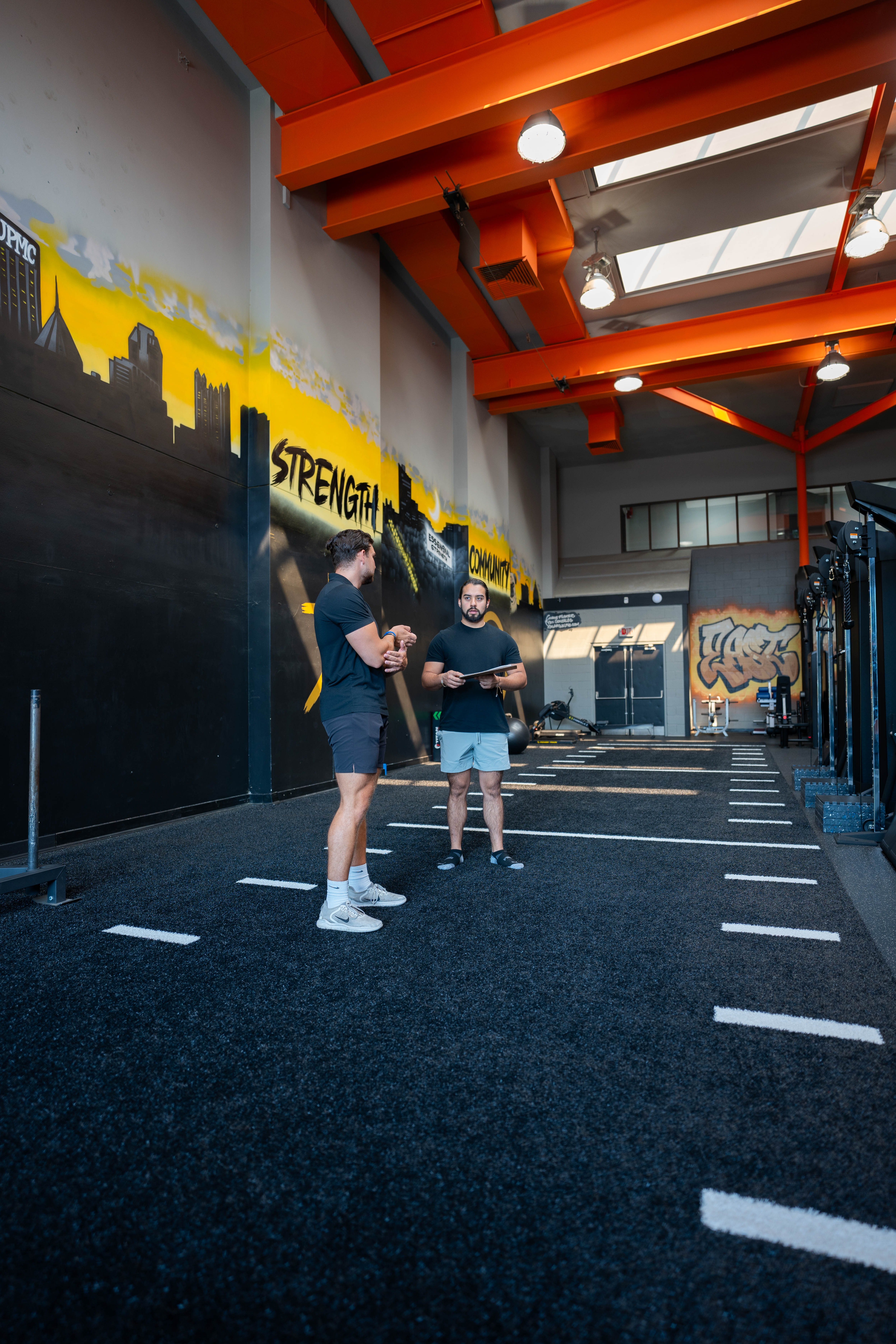
We are a strength training and sports performance facility in Pittsburgh's East End neighborhood. Our clients are people who are serious about results — not hobbyists looking for a general workout, but people with a specific problem they want solved or a level they want to reach.
We work with professionals managing chronic pain who want to get ahead of it before it becomes a surgical conversation. We work with athletes who have stalled and need a more sophisticated program. We work with people who are tired of feeling like they're operating below capacity and want to change that.
Every client starts with a free consultation. Not a tour and a price sheet — a real conversation. We want to understand what you've tried, what's worked, what hasn't, and what you're actually trying to accomplish. From there, we build a program that's specific to you.
We serve clients from Shadyside, Lawrenceville, Squirrel Hill, East Liberty, Highland Park, Oakland, Fox Chapel, and throughout Pittsburgh. Your first session is always free.
In most cases, the answer is programming and accountability. Generic programs produce generic results — or none at all. The clients who didn't get results from previous trainers are almost always describing a situation where the program wasn't individualized, the coach wasn't tracking progress, or the relationship wasn't built on real accountability. A different coach with a different system produces a different outcome. That's what the consultation is for — to make sure we're actually the right fit before you commit to anything.
Most clients notice meaningful changes in energy, movement quality, and sleep within 3–4 weeks — before visible physical changes appear. Visible body composition changes typically emerge at 6–8 weeks with consistent training and nutrition. The clients who see the fastest results are usually those who commit to at least 2 sessions per week and engage with their program between sessions.
Your first session is a free consultation with no commitment. From there, we offer packages and monthly memberships with flexible terms. We don't pressure people into large upfront commitments before they've experienced the coaching. Our goal is to earn your continued investment by delivering results — not to lock you in on day one.
For most goals — building strength, improving body composition, managing pain, improving athletic performance — 2 to 4 sessions per week produces the best balance of stimulus and recovery. One session per week can maintain fitness but rarely produces transformative change. We'll recommend a frequency based on your recovery capacity, lifestyle, and goals — not what maximizes our revenue.
That's often exactly why people come to us. We work with clients who have been told by their doctor to "stay active" post-injury, clients managing chronic conditions, and clients who have pain that hasn't been diagnosed but limits what they can do. Our first consultation always includes a movement assessment. If what you need is beyond our scope, we'll tell you honestly and refer you to the right provider.
Start with the free consultation. It costs you nothing, and it's the same conversation we'd have on day one of your training — just without the equipment. We'll go through your history, your goals, what's blocking you right now, and what a program would realistically look like for you.
No pitch. No pressure. Just an honest conversation. Schedule and assessment below.
Get exact pricing for your goals in one free 30-minute call — no pressure, no upsell. Book a free 30-minute consultation — we cap our roster, so requests are reviewed in order.
After you submit this form we will be in contact within 24 hrs to set up an appointment to come into our East Liberty location for a performance assessment.