%20(2).png)
You passed your physical therapy discharge tests. Your surgeon cleared you to return to sport. Your pain is gone, your range of motion is back, and on paper, you're ready to play.
So why do 1 in 3 athletes re-tear their ACL within two years of returning?
The answer isn't bad luck, and it's not a fluke. It's a gap in the standard rehab process — one that leaves athletes structurally cleared but not athletically prepared. And the 6-month window right after PT discharge is the most important — and most wasted — period in the entire recovery journey.
Physical therapy after ACL reconstruction does exactly what it's designed to do: reduce swelling, restore range of motion, rebuild basic quad and hamstring strength, and get you moving without pain. For most insurance-covered rehab programs, that's where the work ends.
The problem is that "moving without pain" and "ready for sport" are completely different standards.
When you're on a basketball court, a lacrosse field, or a soccer pitch, your ACL isn't being tested by a straight-leg raise. It's being tested by a cutting sprint at full speed, a landing from a contested jump, a collision on an uneven surface. These are multi-directional, high-force, split-second demands — and standard PT doesn't prepare you for them.
This isn't a knock on physical therapists. They're working within a system that has real constraints. The gap isn't their fault. It's structural.
But it is your problem to solve.
Research consistently shows that re-injury rates are highest in the first two years after ACL return-to-sport clearance. The highest-risk period is the first six months back. This is exactly when athletes are most confident — and least prepared.
Here's what's happening underneath the surface during those first six months:
Strength asymmetry. Most athletes return to sport with a 15-25% quad strength deficit in the injured leg compared to the healthy leg. The threshold for safe return to sport is generally considered to be less than 10%. PT discharge rarely gets you there.
Neuromuscular control gaps. The ACL isn't just a mechanical stabilizer — it's loaded with nerve endings that communicate position and load information to your brain. After reconstruction, that feedback system is disrupted. Rebuilding it takes months of progressive, intentional loading. Most rehab programs don't go far enough.
Psychological readiness. Fear of re-injury is real, and it changes how athletes move. Athletes who haven't been systematically exposed to sport-like loading in a controlled environment tend to compensate — guarding the injured leg in ways that put even more stress on the joint.
The six-month window after PT discharge is when all of these issues can be directly addressed — if you're working with the right program.
Bridging the gap between "pain-free" and "sport-ready" requires a level of specificity that most general gym programs can't provide.
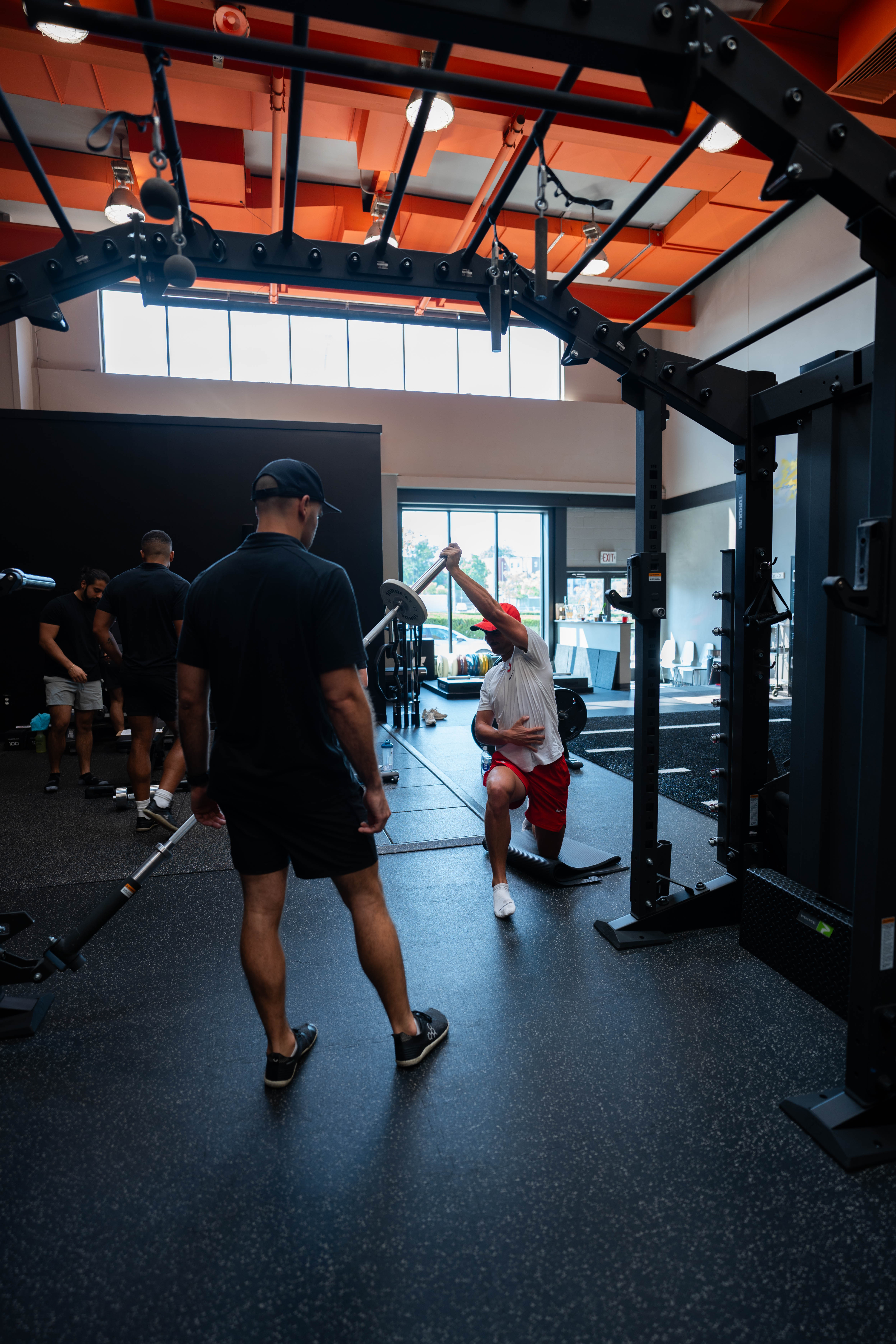
At Essential Strength, the process starts with objective data. We assess your strength symmetry using force plate testing, evaluate your movement patterns under load, and analyze the biomechanics specific to your sport's demands. This gives us a baseline that's actually tied to your injury risk — not a gut feeling.
From there, we build a progressive loading program that targets three things:
1. Strength symmetry restoration. We systematically close the gap between your injured and healthy leg through single-leg loading progressions, posterior chain development, and targeted quadriceps work. The goal isn't "strong enough" — it's balanced.
2. Neuromuscular re-education. This is the work most people skip. Plyometric progressions, reactive drills, and landing mechanics training retrain your nervous system to trust the knee under dynamic conditions. This is where re-injury risk drops.
3. Sport-specific loading. We deconstruct the physical demands of your specific sport — the cutting angles, the jump-landing patterns, the deceleration loads — and build them into your training progressively. By the time you step back onto the field, you've already rehearsed what the game will ask of you.
Getting discharged from physical therapy is an important milestone. It means you've healed. But healing and training for the demands of competitive sport are two separate things — and treating PT discharge as the end of the process is one of the most common and costly mistakes athletes make.
The athletes we work with at Essential Strength who go through a full return-to-sport strength program don't just get back to their sport. They come back stronger, more resilient, and more confident than they were before the injury. That's not a marketing claim — it's a measurable outcome we track.
If you had an ACL reconstruction and you're somewhere in that post-PT window right now, the best thing you can do is not wait until something goes wrong to take this seriously.
Come in for a free assessment. We'll tell you exactly where you stand — objectively — and what it would take to get you fully ready.
Learn more about The Rebuilder program →
Samuel Pitcairn, MS, is the founder of Essential Strength Pittsburgh. He is a Sports Scientist who has worked with the University of Pittsburgh's men's and women's basketball programs and previously led UPMC's return-to-play program for injured athletes.
After you submit this form we will be in contact within 24 hrs to set up an appointment to come into our East Liberty location for a performance assessment.