The Golfer Over 50 Is Not Declining. He's Just Untrained.
Training
%20(2).png)
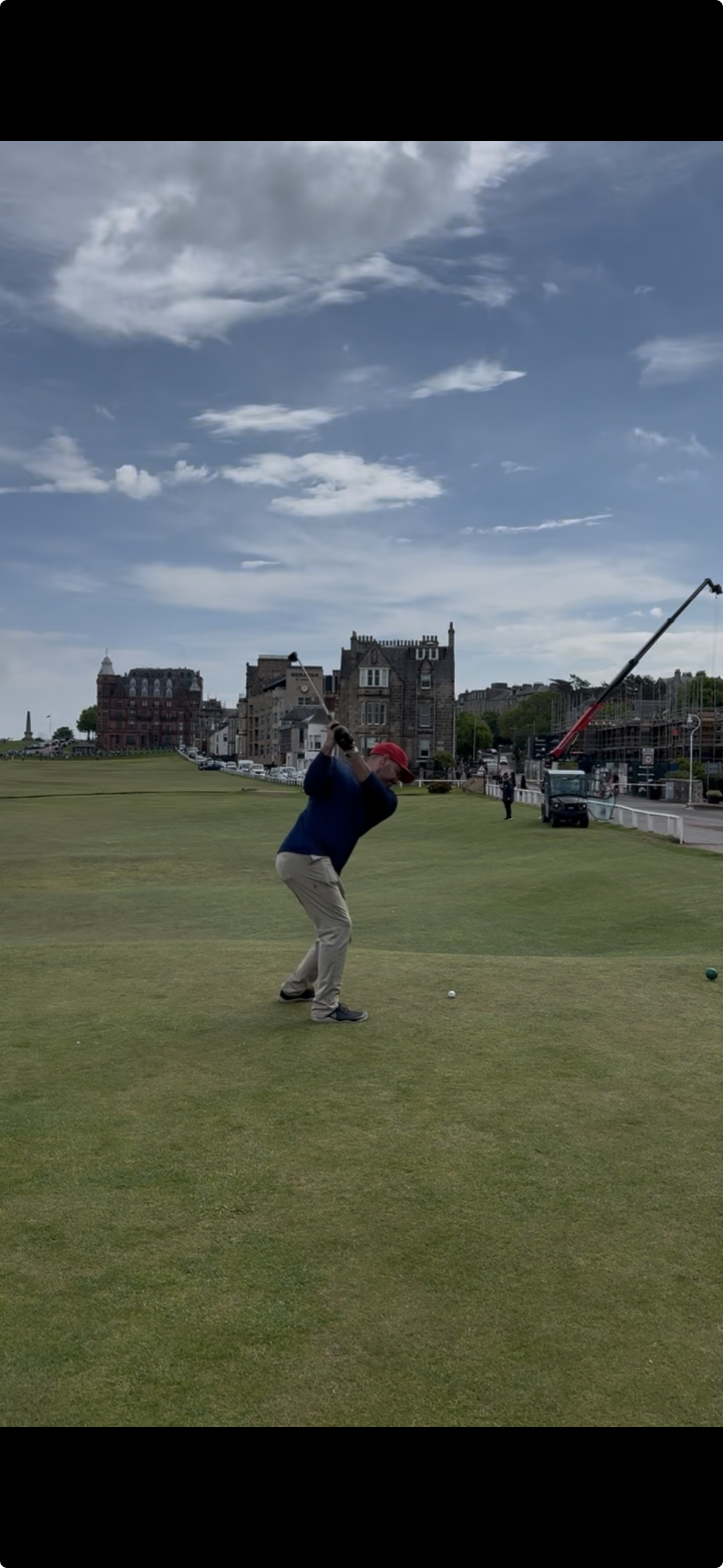
Walk into any golf club in Fox Chapel, Sewickley, or Upper St. Clair on a Saturday morning and you will see the same man at every tee box.
He is somewhere between 52 and 67. He played college sports. He was athletic once. Now he stands over the ball with a brace on his left knee, ibuprofen in his bag, and a swing that produces a back spasm four times a season. He has spent $800 on a new driver, $300 on a launch monitor session, and approximately zero dollars on fixing the body that is swinging the club.
He tells himself this is just aging.
It is not aging. It is neglect. And it is completely reversible.
This article is for that man. Because I have trained hundreds of him. And what he needs is not a stretching routine, not a foam roller, and not a prescription for Meloxicam. What he needs is to understand one foundational truth that will change how he trains, moves, and plays for the next 20 years.
Strength is the mother of all physical qualities.
That phrase belongs to Charles Poliquin — arguably the most accomplished strength coach the sport has ever produced, and a man who did not deal in comfortable lies. What it means is this: every physical quality you care about — power, mobility, endurance, injury resilience, balance — is downstream of strength. You cannot be explosively powerful without being strong. You cannot truly own your mobility without being strong through your range of motion. You cannot recover from injury or resist it in the first place without adequate muscular strength.
For the man over 50, this is not an academic point. It is the single most important piece of information available to him.
Let's be precise about the physiology, because vague references to "getting older" do not help anyone.
After age 40, men lose approximately 1% of muscle mass per year in the absence of resistance training. This process — sarcopenia — accelerates meaningfully after 50. More critically, Type II muscle fibers (the fast-twitch fibers responsible for explosive power, rapid deceleration, and force production) atrophy at a disproportionately higher rate than Type I fibers.
This matters enormously for golf. The golf swing is not an endurance event. It is a ballistic, rotational power expression that is over in less than two seconds. It is almost entirely dependent on Type II fiber recruitment. When those fibers atrophy, your clubhead speed drops, your distance collapses, and your body — lacking the muscular buffer to absorb force — starts dumping that stress into your joints.
Your back doesn't hurt because you played 18 holes. Your back hurts because the musculature that was supposed to stabilize and protect your spine during a 95-mph rotational load is no longer adequate for the job.
This is also why the knee starts to go. The quadriceps and hip abductors that protect the medial compartment of the knee during the weight transfer of a golf swing have been steadily atrophying since you stopped doing anything that challenged them. The cartilage is absorbing stress that muscle was supposed to.
The good news — and there is substantial good news — is that muscle responds to training at any age. The research on resistance training in men over 50, 60, and even 70 is unambiguous: meaningful hypertrophy and strength gains are achievable. The stimulus-response relationship does not disappear with age. The timeline may shift slightly. The programming must be intelligent. But the adaptation is real.
You cannot talk intelligently about golf performance or lower body pain without a framework for understanding how the joints interact. The one I use — and trust — comes from the Gray Institute, the gold standard in Applied Functional Science and movement-based assessment.
The Gray Institute teaches a principle that sounds simple but has enormous clinical implications: joints in the body alternate between roles of mobility and stability as you move up the kinetic chain.
Starting from the ground:
When a joint that needs mobility loses it, the joint above or below it — which is supposed to be stable — is forced to compensate by producing the motion the restricted joint can't provide.
This is not a theory. This is a clinical observation that explains the majority of chronic musculoskeletal pain in the adult population.
Here is the golfer's nightmare version of this chain reaction:
Restricted ankle dorsiflexion (from years of sitting, poor footwear, or simple disuse) forces the knee to collapse inward to compensate during the backswing and downswing. That medial knee stress, over hundreds of rounds, contributes to the knee pain he is already attributing to "wear and tear."
Restricted hip internal rotation — the single most underappreciated mobility deficit in the adult male population — means the golfer cannot properly load his trail hip in the backswing or clear his lead hip through the downswing. His body compensates by wrenching the lumbar spine into rotation to manufacture the range of motion his hips cannot provide. The lumbar spine, as we covered, is designed for stability, not rotation. It has roughly 13 degrees of total rotation available. Asking it to produce 45 degrees of swing rotation is how you build a herniation, a facet irritation, or a persistent SI joint dysfunction.
The fix is not to stretch harder. Passive stretching does not change the neuromuscular reality at end-range. The fix is to restore active, loaded mobility at the hip and ankle — and then build strength around that new range so the body trusts it under the demands of an athletic movement.
Here is where the fitness industry has failed this population. The marketing around "golf fitness" has been captured by the corrective exercise crowd — bands, balance boards, half-foam rollers, and cable rotation drills that would embarrass a physical therapist.
These tools are not worthless. But they are insufficient. And they are being offered as a substitute for the one intervention that actually changes the physiological landscape: progressive resistance training with compound, multi-joint movements that load the body the way life loads it.
The Gray Institute framework is not about identifying a weakness and doing an isolation exercise for it. It is about understanding that the body moves as a chain, and that training should challenge that chain in all three planes of motion — sagittal, frontal, and transverse — under meaningful load.
For the golfer over 50, this translates to a training philosophy built on four pillars:
1. Hip-dominant posterior chain strength — Romanian deadlifts, trap bar deadlifts, single-leg variations. This is the engine of rotational power. The glutes, hamstrings, and adductors are what generate the ground reaction force that travels up the kinetic chain and becomes clubhead speed. A weak posterior chain is a short drive and a broken back.
2. Anterior core anti-rotation strength — Pallof presses, half-kneeling cable variations, dead bugs. Not crunches. Not planks held for five minutes. Anti-rotation work. The core's primary job in the golf swing is to transfer force without leaking — to act as a stiff connector between the lower body's power generation and the upper body's delivery. A soft, poorly recruited core dumps energy and loads the spine.
3. Loaded hip and ankle mobility — This is where the Gray Institute principles and Functional Range Conditioning intersect. We do not just stretch the hip into internal rotation. We load it there. We do not just mobilize the ankle. We build strength through the dorsiflexion range under load. Mobility without strength is instability. And instability at high speed is injury.
4. Single-leg stability and proprioception — The golf swing is fundamentally a single-leg loading event. At the top of the backswing, the trail leg is loaded. At impact and follow-through, the lead leg is loaded. If a man cannot control his body on one leg under load, he cannot control a 95-mph rotational chain on one leg. Single-leg Romanian deadlifts, Bulgarian split squats, and loaded step-ups are not optional accessories — they are the foundation.
Let me be direct about what I see in the gym, because this matters.
Most men over 50 who come to me with golf-related back pain have been told the following by someone in the medical system: rest, stretch, anti-inflammatories, possibly an injection, possibly imaging that reveals "degenerative changes consistent with age."
That last phrase is particularly insidious. "Degenerative changes consistent with age" is used to normalize a finding and close the conversation. But degenerative changes are present on MRI in a significant percentage of asymptomatic adults over 50. They are not necessarily the source of pain, and they are absolutely not a reason to stop loading the spine.
Research published in the American Journal of Neuroradiology found that among asymptomatic individuals over 50, more than 80% had evidence of disc degeneration on MRI, and nearly 40% showed disc bulges. These people were not in pain. The structure was not the problem.
The problem is almost always a movement problem. A strength problem. A stability problem. And those problems have a training solution.
For the knee: the medial compartment pain that plagues the golfer over 50 is, in the majority of cases, a soft tissue problem — inadequate quadriceps strength, inadequate hip abductor control, and restricted ankle dorsiflexion driving valgus collapse at the knee. All of these are training problems.
The injection may buy you a season. The surgery may provide temporary relief. But if you do not address the movement deficit and the strength deficit, the pain returns. Every time.
This is a sample two-day strength and mobility block. It is not a complete program — complete programs are built individually following a movement assessment. But it reflects the principles above and gives you a starting point.
Perform twice per week. Full rest between sets is required to maintain load quality. Do not rush. You are not in a cardio class.
A1. Trap Bar Deadlift
A2. 90/90 Hip Internal Rotation — Loaded PAILs/RAILs
B1. Single-Leg Romanian Deadlift (Dumbbell)
B2. Ankle Dorsiflexion Wall Drill — Loaded
C1. Pallof Press (Half-Kneeling)
A1. Bulgarian Split Squat (Rear Foot Elevated)
A2. Cable Pull-Through
B1. Low-to-High Cable Woodchop (Rotational)
B2. Seated Dumbbell External Rotation
C1. Heels Eleveated Squat with Pause
You are not declining. You are undertrained.
The back pain, the knee pain, the fading distance, the stiffness at the turn — none of this is destiny. It is the predictable consequence of a body that has not been systematically challenged in years, now being asked to perform a ballistic athletic movement 200 times per round.
The solution is not a new driver. It is not ibuprofen. It is not a visit to a practitioner who will normalize your decline with a reference to your age.
The solution is to train. Intelligently. Progressively. With a coach who understands biomechanics, the kinetic chain, and how to build the physical foundation that makes your golf swing a weapon instead of a liability.
If you are a man over 50 in Pittsburgh, Fox Chapel, Sewickley, Shadyside, Mt. Lebanon, or Upper St. Clair who is serious about playing the best golf of your life and staying out of the orthopedic surgeon's office for as long as possible, book an assessment at Essential Strength.
We will find where your chain is broken. We will build it back stronger than it was before. And you will hit the ball past people who are half your age.
That is not a sales pitch. That is physiology.
[Schedule An Assessment]
Samuel Pitcairn is the founder of Essential Strength in East Liberty and Bethel Park, Pittsburgh. He holds a graduate degree in Sports Science and Biomechanics from the University of Pittsburgh.
Want your distance back? Train with coaches who build golfers' bodies — hips, rotation, and power — not just swings. Book a free 30-minute consultation — we cap our roster, so requests are reviewed in order.
After you submit this form we will be in contact within 24 hrs to set up an appointment to come into our East Liberty location for a performance assessment.